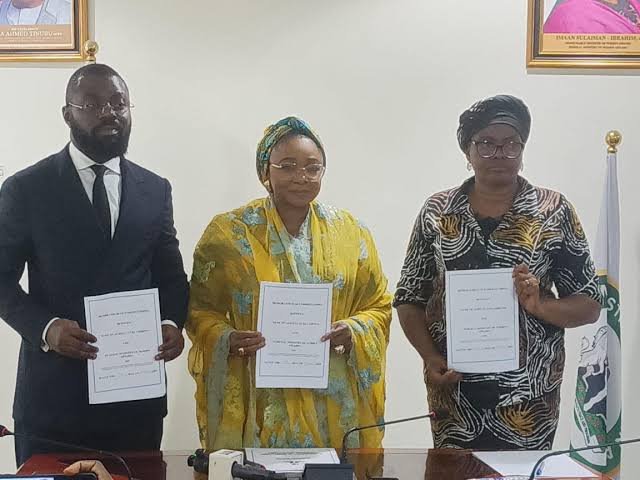

The Federal Ministry of Women Affairs and Social Development has entered into a partnership with the Bank of Agriculture (BOA) to expand agricultural opportunities for three million women under the Women Agro-Value Expansion (WAVE) programme.
The collaboration, formalised through the signing of a memorandum of understanding (MoU), is designed to improve women’s access to agricultural financing, mechanisation and opportunities across the country’s agricultural value chain.
Speaking at the signing ceremony in Abuja on Tuesday, the Minister of Women Affairs and Social Development, Hajiya Imaan Sulaiman-Ibrahim, said the initiative supports President Bola Tinubu’s Renewed Hope Agenda by promoting food security and strengthening women’s economic participation.
She noted that although women contribute significantly to agricultural production, many remain unable to expand their enterprises because of limited access to finance and essential production resources.
“This MoU with the Bank of Agriculture fills the critical financing gap confronting women in agriculture.
“Women are already farming, but many cannot scale because they lack access to finance and support.
“Access to finance will move women beyond smallholder farming into agro-entrepreneurship, creating agro-billionaires,” she said.
According to the minister, the WAVE programme will create opportunities for women across the agricultural value chain, including mechanised farming, input distribution, processing and other agribusiness ventures.
She added that participants would also receive education, digital tools and other forms of support to improve productivity and build successful agricultural enterprises.
Ms Sulaiman-Ibrahim disclosed that about 33,000 women had already registered interest in the programme, while the Federal Government aims to reach three million beneficiaries over the coming years.
She encouraged women nationwide to take advantage of the initiative, stressing that empowering women economically would have positive effects on families, communities and national development.
“Women are the solution. We must attract more women into agriculture and create opportunities that amplify the gains of this partnership,” she said.
Earlier, the Managing Director of the Bank of Agriculture, Ayo Sotinrin, reaffirmed the bank’s commitment to increasing access to agricultural finance for women, noting that they constitute a large proportion of the institution’s dependable loan beneficiaries.
He said the bank would provide support through input financing, mechanisation and other interventions aimed at improving agricultural productivity and raising incomes.
Mr Sotinrin explained that beneficiaries would have access to improved seeds and other agricultural inputs at subsidised interest rates to enhance crop yields.
“Instead of one tonne per hectare, farmers can harvest up to five tonnes through improved seeds and better support. Raising productivity remains Nigeria’s most pressing agricultural priority,” he said.
He further disclosed that women would also be able to acquire tractors at subsidised rates, with repayment spread over three to five years.
“A woman can acquire a tractor, provide services to farmers and repay gradually until she owns it outright.
“This strengthens the business case for women in mechanisation,” he said.
Mr Sotinrin added that BOA would collaborate with farmer cooperatives and aggregation companies to improve loan accessibility, strengthen repayment systems and expand agricultural financing nationwide.
He expressed confidence that the initiative would also attract additional support from development partners and relevant government agencies.
Earlier, the Permanent Secretary of the ministry, Esuabana Nko Asanye, said the agreement would help transition women from subsistence farming to commercial-scale agriculture.
She explained that the programme would provide beneficiaries with mechanisation services, access to finance, improved seeds, demonstration farms and technical agricultural training.
Ms Asanye added that participating women would have opportunities to become tractor owners and operators, seed producers, input suppliers and agribusiness managers.
“The programme begins modestly but progressively empowers women to become financially independent,” she said.
She noted that the initiative would enhance women’s earnings, improve household livelihoods and contribute to increased national food production.