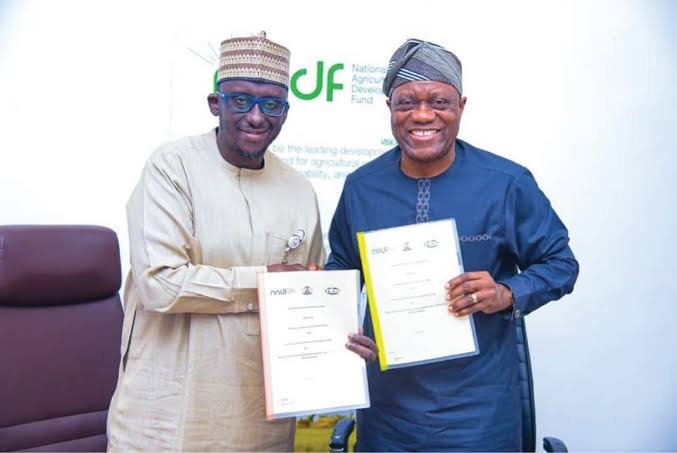

The National Agricultural Development Fund (NADF) and the National Bureau of Statistics (NBS) have entered into a memorandum of understanding (MoU) aimed at enhancing the generation, validation, exchange and analysis of agricultural data to support informed decision-making across Nigeria’s agricultural sector.
The agreement is expected to strengthen evidence-based financing, policy formulation and investment by improving the availability and quality of agricultural statistics.
Speaking during the signing ceremony on Friday in Abuja, the Executive Secretary of NADF, Mohammed Ibrahim, described the MoU as the start of a strategic collaboration focused on improving the production and application of agricultural data.
He said dependable statistics are essential for effective planning, agricultural development, programme execution and evaluating the impact of interventions.
According to him, the partnership will equip the fund with the information needed to make sound investment decisions and implement more effective programmes throughout the agricultural value chain.
Mr Ibrahim noted that although NADF was established by an Act of Parliament in 2022, it has continued to forge strategic alliances to strengthen the execution of its mandate.
He added that the agreement comes at a crucial period as the fund expands its activities in agricultural financing, research, donor coordination and support for sub-national agricultural development.
“Data is our chief enabler. We want every intervention and investment we make to be guided by credible evidence.
“Working with NBS will strengthen our ability to design programmes that respond to real needs and deliver measurable results,” he said.
Earlier, the Chief Executive Officer of the National Bureau of Statistics (NBS), Adeyemi Adeniran, said the partnership demonstrated the shared commitment of both organisations to advancing Nigeria’s agricultural sector through stronger statistical systems and institutional cooperation.
Mr Adeniran explained that the MoU would create a unified framework for exchanging, validating and harmonising agricultural data, ensuring policymakers and investors have access to accurate and dependable information.
“Agriculture deserves better data, and together we intend to build it because reliable statistics remain the foundation of good governance, sound planning and effective investment,” he said.
He said improved data collaboration would enhance monitoring of agricultural programmes, guide investment decisions and strengthen national food security by ensuring that policies are driven by evidence rather than assumptions.
Mr Adeniran, who also serves as the Statistician-General of the Federation, assured stakeholders that both organisations would uphold strict standards of data governance and confidentiality throughout the implementation of the agreement.
He also praised NADF’s expanding contribution to agricultural development and expressed optimism that the collaboration would produce meaningful benefits for farmers, investors and policymakers.
Also speaking, Nasir Ingawa of NADF’s Partnership and Investor Relations Department said the signing of the MoU marked the formalisation of a long-standing working relationship between the two institutions.
He noted that the collaboration would reinforce ongoing efforts to ensure agricultural programmes and investments are guided by credible, fit-for-purpose data.