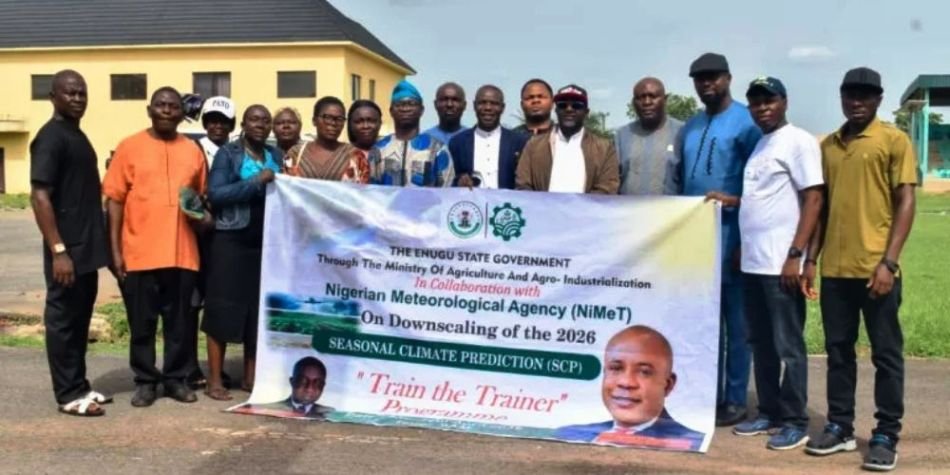

The Enugu State Government has intensified efforts to strengthen agricultural resilience by training farmers to better understand changing weather conditions and apply climate knowledge to their work.
At a series of workshops held across the state, officials explained that the initiative aims to bridge the gap between scientific weather forecasts and everyday farming decisions. The programme, organized by the Ministry of Agriculture and Agro-Industrialization in partnership with the Nigerian Meteorological Agency, focused on interpreting the 2026 seasonal climate outlook for practical use in rural communities.
Commissioner for Agriculture, Dr Patrick Nwabueze Uburu, said the training reflects the administration’s broader plan to modernize agriculture and improve food production. He noted that participants were selected to pass on what they learned to others in their communities, ensuring the knowledge reaches as many farmers as possible.
He explained that a similar exercise carried out the previous year produced encouraging results, as farmers began to adjust planting schedules and monitor rainfall more carefully. According to him, the expansion of the programme to cover all senatorial zones demonstrates the government’s resolve to deepen its impact.
Participants are expected to return to their wards and educate fellow farmers, while also providing feedback through reports and field demonstrations. The state has also introduced demonstration farms where practical lessons on weather patterns and crop performance can be observed.
Experts at the workshop highlighted the growing challenges posed by unpredictable rainfall and temperature changes. A university professor who addressed participants stressed that farmers must understand key factors such as the beginning and end of the rainy season, as well as the duration of growing periods, in order to plan effectively.
He warned that climate related shocks such as flooding and drought can wipe out investments, affecting both livelihoods and mental wellbeing. To reduce these risks, he encouraged diversification in farming activities and the adoption of improved soil and water management practices.
Meteorological officials provided detailed projections for the coming season, noting that rainfall is expected to begin earlier in southern areas than in northern parts of the country. They also outlined expected timelines for the end of the rainy season and the overall length of the farming period, urging farmers to use this information to guide planting decisions.
Local government representatives who hosted the training sessions described the initiative as timely, especially as many communities depend heavily on agriculture. They emphasized that improved farming practices could boost food production, create income opportunities, and support broader economic stability.
Farmers and agribusiness operators who attended the sessions expressed optimism about the programme. Some said the training had opened their eyes to the importance of climate information, describing it as just as critical as traditional inputs like seeds and fertilizer.
The workshops, which took place over three days in different local government areas, drew participants from across the state. Organizers believe that as the knowledge spreads, more farmers will transition from subsistence practices to more productive and commercially viable operations.